
Introduction
Information Technology (IT) has become the foundation of the modern digital world. Almost every industry today depends on technology to manage information, improve efficiency and support growth. Information Technology focuses on the use of computers, software, networks and digital tools to store, process and share data in an effective and secure way. For students, learning IT is an important step toward building a successful future.
What is Information Technology?
Information Technology refers to the practical use of computer systems and digital technologies to handle information. It includes computer hardware, software applications, networking systems and data management tools. IT helps organizations and individuals perform tasks faster, reduce errors and maintain accurate records. From simple office work to complex online systems, IT supports daily operations in every field.
Importance of IT in the modern world
The importance of Information Technology has increased rapidly due to digital transformation. IT improves communication, saves time and increases productivity. It boosts efficiency and productivity, enhances communication and collaboration. Educational institutions rely on IT for online learning, student management systems, and digital resources. Without IT, modern systems cannot function efficiently and smoothly.
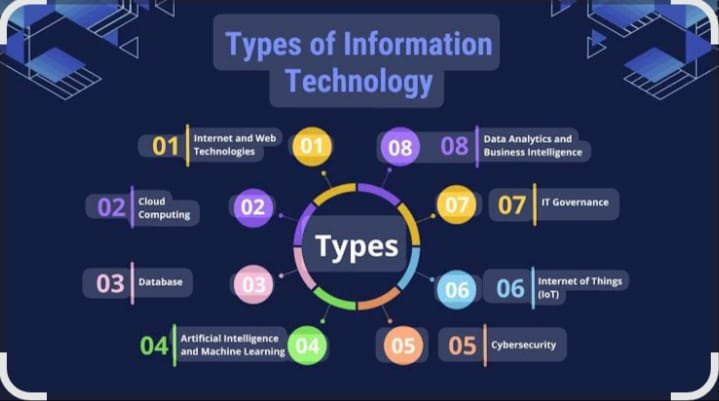
Types of Information Technology
Information technology encompasses a wide range of technologies and systems that are used to store, retrieve, process and transmit data for specific use cases.
Common information technology types include the following:
- Internet and web technologies. This includes the tools and protocols used to access, navigate and interact with information on the internet. Examples include web browsers, websites, web servers, Hypertext Markup Language, JavaScript, HTTP and other internet-related technologies.
- Cloud computing. This involves the delivery of computing resources and services over the internet on a pay-per-use basis. This can include infrastructure as a service, platform as a service, software as a service and cloud storage options.
- Databases. This includes IT systems and software used to store, organize and retrieve data. Examples include MySQL, NoSQL, relational database management systems and MongoDB.
- Artificial intelligence and machine learning. AI and ML-based IT technologies use algorithms and statistical models to enable computers to perform tasks that typically require human intelligence. Examples include speech recognition, image recognition and natural language processing.
- Cybersecurity. This type of IT includes technologies and best practices designed to protect IT systems, networks and data from unauthorized access, cyber attacks and other security threats. Cybersecurity can be enforced through firewalls, antivirus software, encryption, intrusion detection systems and security policies.
- Internet of things. This includes the network of interconnected devices and sensors that collect, exchange and analyze data. IoT technologies enable the integration of physical objects into computer systems, providing automation, monitoring and control in various domains.
- IT governance. This involves making policies and rules for the organization to ensure effective operation.
- Data analytics and business intelligence. BI focuses on tools and techniques for extracting insights from large data sets to support decision-making and business operations. This can include data mining, statistical analysis, data visualization and predictive model.
Future scope of Information Technology
The future of Information Technology is very promising. Emerging technologies such as artificial intelligence, cloud computing, and cybersecurity are creating new opportunities. Continuous learning and skill development in IT can help students stay competitive in the job market and adapt to future technological changes.
Conclusion
Information Technology is a powerful and essential field that supports digital progress in every sector. Learning IT provides students with valuable skills, multiple career paths, and long-term growth opportunities. An Institute of Information Technology plays a key role in shaping skilled professionals who are ready to succeed in a technology-driven world.